
Narcissus pseudonarcissus

Bell narcissus, bobbing on the swell of wind
that licks up the foothills, trumpets filled,
gulping lungfuls of the upslope morning.
Springing mute-lipped, one March day bowed with snow,
the next, by their deep pneumatic will, upright,
flexing, boxing air.

Still, unstill cornets who neither sing nor stop.
Soundless, December’s cellared children,
together tethered to unspeaking kin,
hand on mouth should someone hear, speaking
only through their skin.

What we know of yellow is extracted,
emetic, from their frayed and furrowed flutes.
Use this caustic color with care, she warns:
Spring brings out its fighters first, those with a thirst
for struggle. Picture tinctured spirit, too strong
for pretty idling.

Copyright © 2019 Lilibug Publishing.

Making Garden Gryphons (Ghazal)

They’re never as practical as you will have thought:
Sphinx moths with a real girl’s face? but at least you’ve thought.

The best invent themselves: perhaps a fox hair brush?
Too slow to beat the hawk, too bright — well, we might’ve thought.

Contrived creatures, and never as we’re taught, “nature”:
we will have felt “dragon” but never thought the thought.

A winged lizard — impossible! Do caves give birth?
Unless…combining fear and earth, evil, half-thought…

Beauty never makes a beast, though beauty kills it dead.
Just think with hormones, not with bioactive thought.

A perfect petri dish: some sleep, cold stew, some wine.
Remembering embarrassments she will have thought.

Ta-da! How’s this? A stag’s body, a cat head couched,
its one eye white as pearl, part blind — full blind to thought.

When, like your narcissus, I go to sleep

When she was young
she would sit, singing birdsong trills
and madrigals in her ptarmigan throat.

We were green flesh.
Our thoughts ran together, acid and restless,
and she sang when she was nineteen,
on a California rail,
her voice in the Big Sur fog.

I built her a wedding bed
from pine and mountain hemlock.
We sleep between our whittled angels.

But she no longer sings.
In our wedding bed
her eyes weep diamonds
pressed by the moon
from some ancient pain,
from a cavernous pain.

When I enter her
she oils the sheets,
resinous as a Lebanese tree.

She rests her eyes
from their inlaying
on my arm, her walnut eyes.
There is no wealth
that does not come
from the body of my lover.

Rising for work,
with a handful of gems,
we sweep away the bloodstones
of her grieving.

Tent

I hauled from home
a square of blue cloth
to cover me in the wilderness.

Mosquitoes found me anyway.
Someone had said,
Look for the square of blue cloth.

I hunched deep in my mummy bag,
cave deep,
and then the moon exploded phosphorus
on the cirque meadow.
A hundred million galaxies held their breath.

Over there, the moon said.
Under the blue cloth.

His blood still courses.
He is still warm.
He still pretends
he isn’t
one of us.

Sweet Monster

My husband gone
I raid the fridge, she says.
Not to eat but to pare.
He is happiest when it is full.
I toss out instead
past dated eggs, old olives,
a month-old splash of milk.

Cat food — tossed.
I keep dry vermouth,
muscular carrots,
whole grain bread.
When I am finished
the refrigerator breathes.

I miss him terribly,
but when I walk in
the kitchen is calm.

On the north seat,
the tabby, the young one,
watches me,
quiet without him.
She opens her belly to the sun.

She is my loneliness, too:
sweet monster,
sitting peaceful in my chest,
stretching in the big bed,
purring at the breaking light.

Deer Trail

There have been times
as the season froze or thawed
when watching, you could see their tracks,
deep after warmer days.

Whether they took our path to the woodshop
or took the trail down to the ravine
by the old chicken coop /
or other times,
because the snow suggested it,
carved out their own path
straight down to the road.

We never see them.
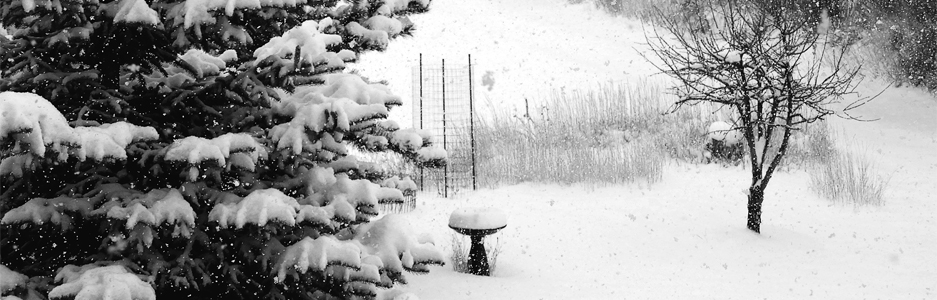
The peach tree and the shade
doesn’t hold them now,
the cold too great.

But in the morning there are new tracks,
bold things that happened in the night,
invisible like us —
along the trail
or off the trail, like us.

Pitcher

Stained with grass and goose shit,
a baseball is a perfect thing.

If you ever felt the difference
between the ball in a bare grip
and the numb wing of the glove
you understand the game.

This pale pill,
stitched skin, Frankenstein monster
wrapping wool, a motley
redeemed by weight,
falls homing in the hand.
Even a statue wants
to make it move,
deliver from its scars
a quiet arc.

Young, I used to throw the ball,
a thing they hit.
Now I throw my love for it.

In the Beauty of the World

On a canyon road
among the piñon pines
we slowed to pass a cow just hit.
She lay on the shoulder,
the globe of her one eye swallowing wild.
Don’t look, Bella, said my mum,
but the massive tongue,
lopsided, licking road,
and the schoolless night,
still warm with crickets,
said look look look.

That isn’t to say, I know,
there is necessarily
beauty in the dimming light:
the sun sets equally on the fetid swamp
and the flatirons
and there is always dumb calm
in letting go
of pushcarts, or people, or hope.

But if the world is our oyster,
wear the pearl — please,
but eat the oyster too,
that too,
because what is it to love
if you cannot love it raw?
and like Rubens,
that fat intensity,
adore Helena for all her farts
and dimpled knees.

She Comes Around

In the photograph from the wildlife camera
she appears at dusk, side-on,
her full tail in the air:
the big ginger cat
from the farm next door.

She is one of those puzzles you find
in newsprint books at the tobacconists
— which one of these doesn’t belong? —
because before and after her on the camera
are a mountain lion and a red fox.

I thought of the two bobcats who came
to the picture window on St. Stephen’s Day
at three o’clock in the morning
looking intently in,
and the man in Finland whose dog got out:
the wolves at the forest fringe
were calling it to come and play.

There was no blood, he said.
The dog just disappeared into their jaws.

Still, she comes around:
again this morning on the deer trail
where she sat gazing up,
the jays and the blackbirds with new hatchlings
diving, exploding into the air,

and her
wearing their worry and disapproval
— even, you think,
their appetites and their hatred,
like a bright blessing,
the urgent chatter of the birds
an electric hum
almost to the horizon.