
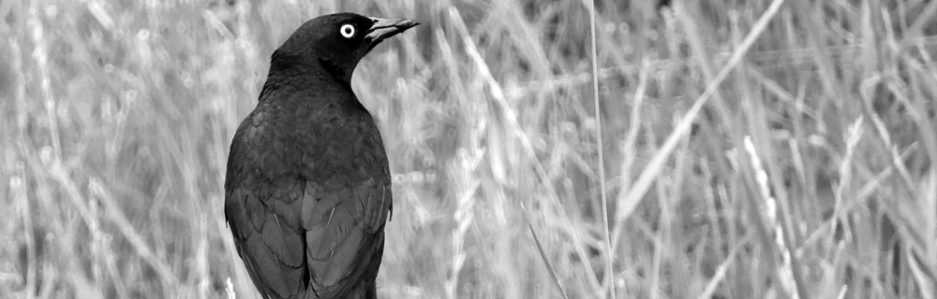
Axis Mundi

It takes a while for the birds
to land, though one or two
blue sentries are always
on the low tumuli of piñon:
scrub-jays sensitive to my morning feet
the creaking door
the crackling of the seed bag or
the soft clank of the bucket’s
handle on the tub

Sound carries here
in sagebrush-juniper
above the valley floor
a whisper half a mile along
our rutted dirt might as well
be whispered in the yurt

and so I fill the feeder knowing
the unknown wild is watching
our Clark’s Nutcracker or the jays
and juncos dropping
from the Sangres in the fall

dropping from the foothills
with the usual messages
about time gone
and smaller days

I tip out empty husks and peanut shells
from the hanging wood and wire
of the little platform

there’s already shuffling deep
in the otherworld of the bough
yet who could tell?
they’re still too liminal for me

ghost birds have started their
lazy, patient circling around my head
weaving a perimeter of sound
Pinyon Jays with their uncanny bleating
and the whistling of Mourning Doves

though all there is to see
is Sis Naajiní on the far horizon
catching the eastern light now
holding up the sky

our white shell mountain
the one initiates climbed
to spend the night in shuddering cold
greeting the early heavens
with an outstretched hand
to feed the gods
humanity

Camera

Every morning, as I go out,
I catch sight of my Nikon
on the hallway dresser
where I have deliberately left it,
charged with promise,
the magic lantern of schoolkids’ stories —
knowing that if I don’t take it
I’m sure to see something astonishing
and only have these dubious words.

I am always right:
the cones of the blue spruce
in the late winter light
drape on the top branches
like streetseller wares, plumbed fruit
hanging from his shoulders.
Or along the base
of our eastern slope,
where stubborn white pelts of snow
depress the prairie grass,
the veins of deer tracks
trickle out and finger.

I take the camera, then,
convinced that I have made
the whole world suddenly dull.
And I am always right:
what I saw in the spruce
I couldn’t tell you,
the tired interminable drupe of the bough /
not at all like vulture wings,
or the ratcatcher swinging
from a shoulder yoke, by their tails,
this late winter catch of cone.
How the deer are gone again,
and left us the mundane definition
of their feet, more loss
than lotuses.

Keeping a Fern Alive in the High Plains

I’m guessing the last thing Custer saw
wasn’t the pied pony dead,
or the infecting iron of the arrow
looping through the air,
the leather of a cartridge belt,
dropped when the man dropped,
but the colorless grass of that knoll in Montana.
It is hard somehow not to blame
the ground for the sky.

Against reason I hang Boston ferns
in the corners of the living room,
and for several weeks, over-fertilized,
still lush for nursery customers,
they pop like vegetable fireworks.

And still for weeks against reason
I take them out to the porch when they pale,
water them again, talk sweetly,
sing them songs of the Queen Charlottes
and Scapa Flow lullabies
when they go,

and think ruefully, comically,
how nothing survives the high plains —
when of course nothing survives
the channel and the undercliff.
We just die wetter on the coast.

Or wonder,
when I put another one out with the trash,
if they dreamed, still damp,
in their dark green potted plastic,
of the shortgrass prairie and the chaparral,
if they were tempted,
like the sibyl suspended in a glass cage,
or the boy in the bubble,
to exit, to open the door,
to say the hell with it,
to hell with all our circumstances
and sentences,
I’m going anyway.